
Zara Live - AI-Powered ESL Practice as a Gateway to Human Instruction
Overview
Spoken language fluency requires repetition and confidence, yet many ESL learners lack access to affordable, low-pressure environments for practice. Zara Live explores how AI can help fill this gap - creating a scalable practice layer that complements, rather than replaces, human instruction.
Existing solutions force a tradeoff. Live peer-to-peer tutoring provides high-quality interaction but is expensive, requires scheduling, and can be intimidating for many learners - especially children. Self-guided language apps scale cheaply, but rarely offer meaningful speaking practice or conversational continuity.
As a result, learners are left without a safe, accessible way to practice consistently between live sessions.
Strategy
Rather than attempting to replace live instruction, Zara Live is designed as a practice and confidence-building layer that sits between self-guided study and peer-to-peer tutoring.
By offering structured, low-pressure speaking and listening practice, the product reduces cost and anxiety for learners while preserving the value of human-led instruction. For education providers, this creates a lower-cost entry point that can serve as a gateway to higher-touch services.
Interaction & Conversation Design
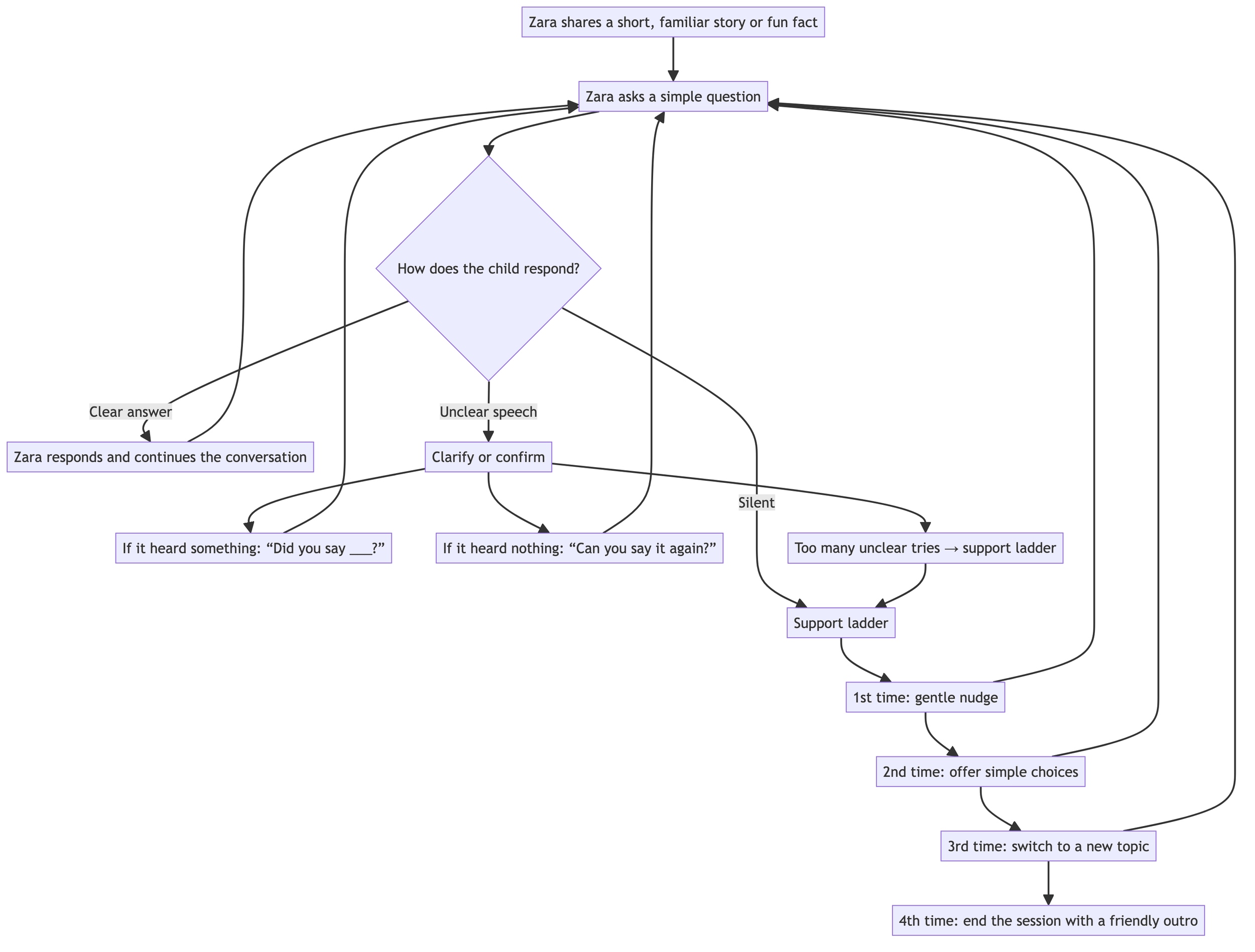
ZaraLive intentionally minimizes on-screen interaction to reduce cognitive load for young learners. With a single entry point into the experience, the primary design challenge becomes conversational: how to invite participation, respond to hesitation, and sustain engagement without pressure or judgment.
User Experience (Minimal by Design)
ZaraLive is designed to minimize on-screen complexity for young learners. Rather than navigating menus or responding to visual prompts, the experience centers on a single, clear action that initiates interaction with Zara.
This design reduces cognitive load, avoids reading-dependent UI, and shifts the primary interaction into guided conversation - where confidence, pacing, and encouragement matter more than interface navigation.

By limiting visual choices, the product avoids overwhelming early learners and ensures that hesitation or silence is treated as part of the learning process, not a failure to use the interface correctly.
AI System Design
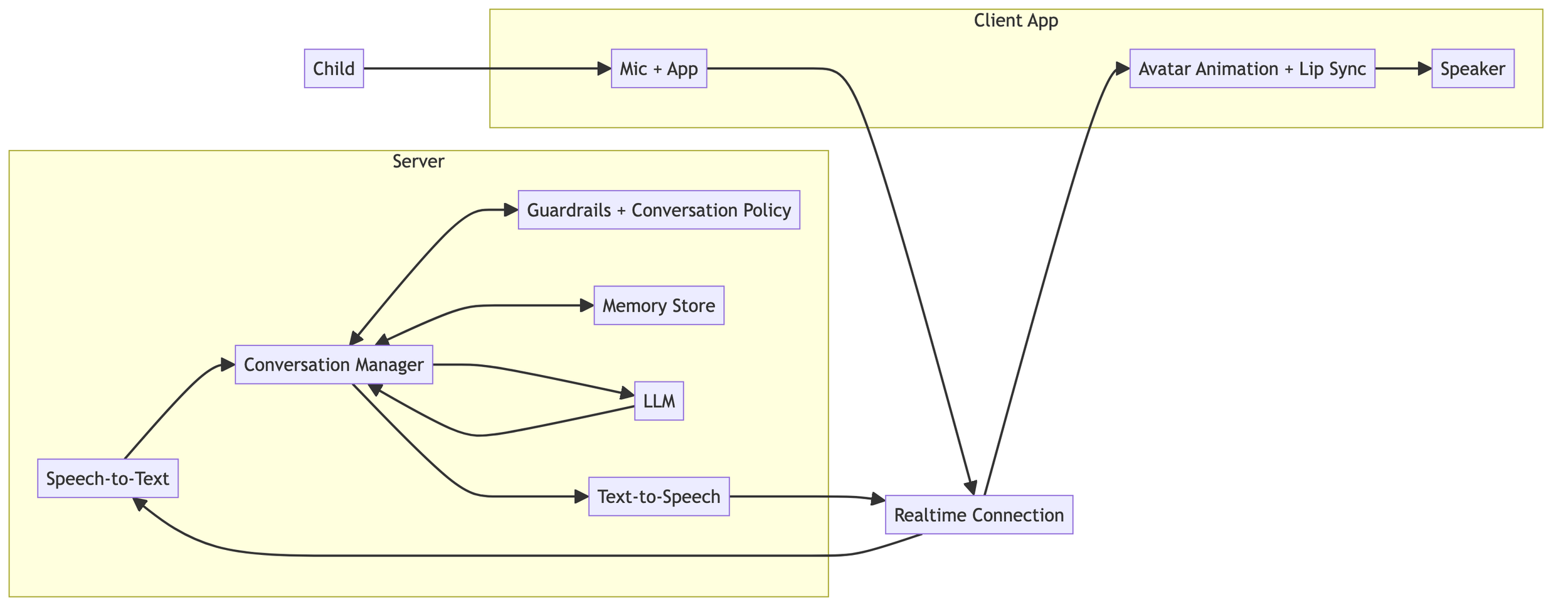
ZaraLive uses a constrained, orchestration-based AI design rather than a fully open-ended chatbot. The goal is predictable, child-appropriate interaction that can recover gracefully from silence, unclear speech, and short answers.
The system decomposes the experience into discrete steps - prompting, understanding, response selection, and safety checks - so each stage can be tested, tuned, and constrained independently. This improves reliability and makes it easier to enforce guardrails appropriate for young learners.
At a high level, ZaraLive combines:
Conversation state (where we are in the loop, including the support ladder)
Memory/context retrieval (optional: prior story/lore + learner preferences)
Response planning (choose next move: affirm, ask, nudge, offer choices, switch topic, close)
Generation (produce child-safe wording)
Policy & safety filters (constrain content and behavior)
Human-in-the-Loop Quality & Safety
ZaraLive is designed to balance creativity with responsibility. Rather than relying on fully open-ended generation, the system supports human-in-the-loop controls that allow a parent, educator, or content team to review and refine content - particularly when introducing new topics, prompts, or story templates.
This approach enables ZaraLive to scale practice while maintaining:
Safety and appropriateness for young learners
Brand and pedagogical alignment for partners using proprietary IP
Continuous improvement informed by real interaction patterns (e.g., silence, short answers, repeated misunderstandings)
Reflection
Zara Live was an exploration into where agentic AI can add value without overreaching. Unlike automation-heavy systems, this project focused on designing interaction, trust, and recovery - especially in a child-facing context where simplicity and predictability matter more than capability breadth.
Several product lessons shaped the work:
1. Identify Where AI Should, and Should Not, Act Autonomously
Rather than building a fully conversational AI tutor, I focused on a narrower but more defensible role: creating a low-pressure practice layer that supports repetition and confidence-building between human-led sessions. This required resisting the temptation to over-automate and instead designing AI behavior that is intentionally constrained, predictable, and supportive.
2. Treat Interaction Design as the Core Product
With a deliberately minimal interface, the primary design challenge shifted from screens to conversation flow. Much of the product value lives in how the system handles silence, unclear speech, hesitation, and session endings. Designing these “failure states” as first-class interaction paths proved more important than expanding surface-level functionality.
3. Decompose Behavior Before Decomposing Systems
Before introducing architecture or models, I mapped the desired conversational behaviors - prompting, nudging, repairing, switching topics, and closing sessions. This behavioral decomposition directly informed the system design, where an orchestrator selects actions and the language model focuses on phrasing rather than decision-making.
4. Prioritize Trust, Safety, and Oversight from the Start
Because Zara Live targets young learners, responsible AI considerations were foundational rather than additive. Human-in-the-loop controls, constrained generation, and cautious topic expansion were built into the product strategy early. This approach favors long-term trust and partner alignment over short-term capability demonstrations.
5. Scope for Learning, Not Novelty
The project intentionally limits feature breadth in favor of learning depth - understanding how learners respond to open-ended prompts, how often nudges are effective, and where confidence breaks down. This focus enables meaningful iteration without increasing cognitive or safety risk.
6. Apply Agentic PM with Restraint
Zara Live reinforced that agentic AI product management is not about maximizing autonomy, but about placing autonomy where it creates value. Combining classic PM principles - user empathy, clear problem framing, and iterative validation - with agentic concepts like orchestration and guardrails resulted in a system that is modest in scope but deliberate in design.